Labeling outspoken women as rebellious won't solve issues
This reflects a patriarchal mindset that prefers women to remain within set boundaries and suppresses their voices.
India is about to enter its 80th year of independence. Over these years, the country has made significant progress. Be it economic development, technology, or education, the nation has embarked on a long and successful journey in every field. However, when it comes to freedom, the status of half of the country's population tells the true story of a nation's independence.
Compared to the pre-independence era, there has been a substantial increase in women's education. Girls have reached schools and universities. They have made their mark in professional fields, and their participation in public life is more visible than ever before. This is certainly a matter of satisfaction and hope.
Amidst the statistics of progress, has the mindset of society changed?
Has our society progressed as much as these statistics of development? Yet, cases of abuse against women, violation of their privacy, and encroachment on their dignity and rights still surface almost every day. The difference is that this intrusion is no longer confined to the four walls of a home or a specific community; it has become widespread. Social media and digital technology have provided women with a platform to express themselves, establish their identity, and amplify their voice, but this technology has also opened new avenues for infringing on their privacy, dignity, and freedom.
Today, women not only have to think about what to say but also how much to say, against whom to say it, and what the cost of saying it might be. Whether it is a woman holding a high public office or a girl making her first voice heard on social media, an invisible boundary is created around her, and it is not acceptable for half the population to speak beyond that boundary. A woman's words often define her character, which is not usually applied to other sections of society.
Why are women's questions still answered with character assassination?
In such a scenario, if a woman raises a question against the injustices happening to her or in society, her opposition is not limited to mere disagreement. She is trolled for speaking up for her rights, threatened with rape, her private pictures are shared on social media without permission to create memes, and sometimes she and her family are even threatened with death. Instead of responding to her thoughts, a large section of society targets her body, her privacy, her character, and her family.
Rising statistics of online harassment and the old method of silencing women
The extent of this problem can be gauged from the data of the National Cyber Crime Reporting Portal of the Ministry of Home Affairs. According to government data, complaints related to online harassment, stalking, and obscene messages increased from 11,641 in 2020 to 39,077 in 2024. This is not a specific statistic for women, but it certainly shows the seriousness of the growing problem of harassment in the digital world.
This is the perspective of a patriarchal society that always wants to see women within their limits and has become accustomed to controlling their voices. There are many examples of how a section of society is disturbed when a woman speaks or raises questions for her rights. During the recent student movement, cases emerged where women and girls were personally targeted for participating in the movement, raising their voices, and making reels on social media, and every possible effort was made to suppress them.
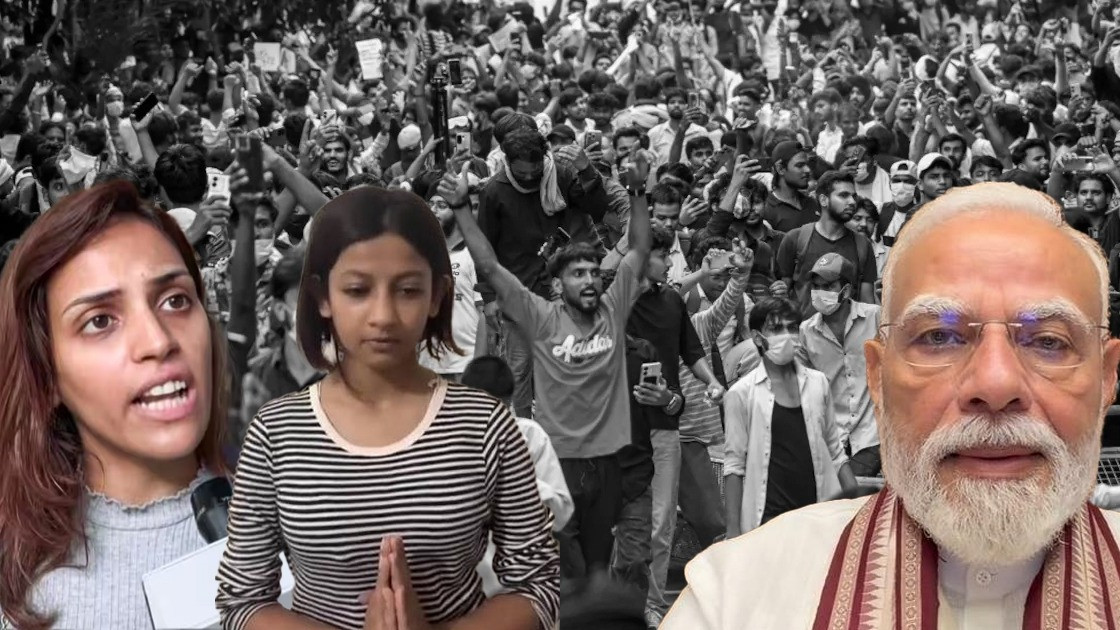
During the Jantar Mantar protest, after a minor girl's alleged objectionable statement on social media, she and her family were targeted. Later, she was also made to apologize publicly. In such a situation, will that girl's mental state ever be such that she can rise again and raise her voice for her rights? Similarly, Rhea Ahir, who came into the limelight from the movement, also faced online trolling, threats, abuse, and character assassination.

There were even attempts to defame her using her old pictures, which led her to file a complaint with the cyber police. Meanwhile, AISA's national president Neha Bora, who has been actively involved in the NEET paper leak case, was inked by miscreants in Ranchi, showing that while we are advancing in science and technology, as a society, we are still victims of narrow and backward thinking.
Is questioning power a democratic right or a matter of culture?
One thing is common in these incidents. Even today, our patriarchal society is trying to silence women's voices instead of responding to them. Even today, society treats an educated woman the same way it treated women like Savitribai Phule and Fatima Sheikh, who lit the lamp of education in the 80s. Even today, the response to an educated woman's question is character assassination. The extent is that most of those who do this to women roam freely and fearlessly. No action is taken against them, and sometimes they even receive government protection.
Often, governments themselves stand on the side of society where the rights and voices of women and girls are crushed.
Recently, a case involving a national taekwondo player in Uttarakhand also highlights this issue. When the female player presented her sports achievements and the financial hurdles in playing at the international level to Chief Minister Pushkar Singh Dhami, he ignored her words. But when the video of this incident went viral, another video of the same girl surfaced, in which she clarified her previous statement.
This entire episode certainly raised a fundamental question. When a girl stands before power with her complaint, does she get a safe environment to fully express herself? Is the government so afraid of tarnishing its so-called good image that it pressures girls to apologize or changes their statements?
In a democracy, citizens are the people, not subjects; why is their questioning seen as indiscipline?
This pressure is not limited to social media. After the recent protest at Jantar Mantar, Prime Minister Narendra Modi made a reel reacting to the abusive language used by children during the protest and initiated a new trend of apologizing. Through the reel, there was a forced attempt to fit the children's protest into the mold of deviation and mischievous behavior. Although questioning the propriety of language is absolutely right, no kind of abuse should be supported in any protest or demonstration. But in a democracy, the bigger question is whether a citizen's dissent should be linked to their culture.
Do girls who question the government need to be taught to speak with decorum? Should they be punished for questioning the government? The answer to these questions is that the government itself needs to understand that questioning in a democracy is a citizen's right, and they will continue to do so. The Prime Minister and his party members need to understand that they are the elected representatives of the country, not the fathers of the people. The people have given them power so that they remain accountable for governance, not so that when the people question them, they are taught a lesson in culture. In a healthy democracy, dialogue, agreement-disagreement, and questioning between leaders and citizens are not weaknesses of democracy but its greatest strengths.
If a woman questions power, labeling her as spoiled, uncultured, or misguided is not an answer to that question. It is merely an extension of that patriarchal mindset, where a woman's independent voice is seen not as freedom but as breaking discipline. This attack is not limited to ordinary women but engulfs every woman who speaks against oppression. Whether it is the Gen Z girls protesting at Jantar Mantar, a female athlete bringing gold medals for the country, an actress expressing her opinion against the government, a journalist, a writer, or a human rights activist, no one is safe. Anyone who has a voice is targeted by a frustrated society and power.
The true progress of the country will be determined by the freedom of women
The irony is that all this is happening in a country that calls itself the world's largest democracy. Our Constitution grants women equality, freedom, dignity, and the right to raise their voices for their rights. Governments formulate women empowerment schemes, talk about the education and safety of daughters. But in reality, when the same daughter asks questions, protests, or stands up to power, her voice is crushed. Merely providing a platform for a woman to speak is not enough. True freedom is giving her the liberty to speak on that platform without fear, without humiliation, and without any invisible social barriers.
The question is not how many rights we have given to women. The question is whether our society and our system are ready to accept women who exercise those rights. Because the true progress of a country is not measured by the size of its economy, how advanced its technology is, or how improved its development statistics are. The true progress of a country is also measured by how freely and with how much self-respect its half population lives.
Therefore, the real development of the country will happen when women in the country can speak about their rights, stand up to society and power, ask questions, and instead of being silenced, they are given answers.