
All 11 Muslim accused acquitted in 2022 Khargone violence case

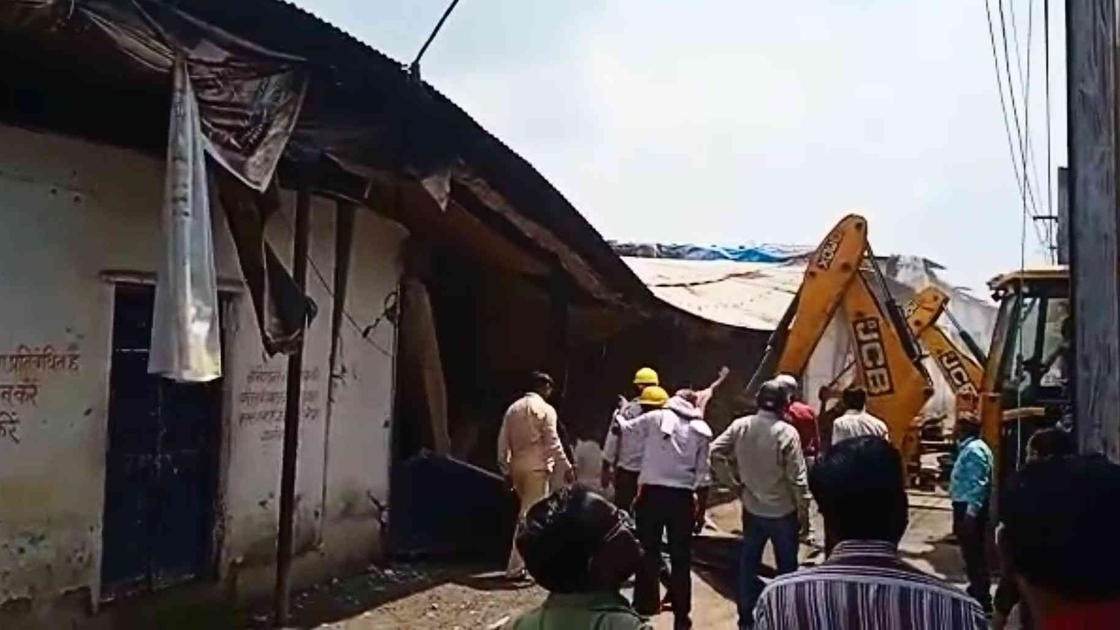
Violence erupted during the Ram Navami procession in Khargone, Madhya Pradesh, in 2022.
In Madhya Pradesh's Khargone, a local court has acquitted 11 Muslim community members accused in the 2022 Ram Navami procession violence case. This decision came after legal defence led by the 'Association for Protection of Civil Rights' (APCR).
According to a report by Live Law, the verdict was delivered on Monday by the Additional Sessions Judge's court in Khargone (Mandleshwar). The case was linked to crime number 237/2022 registered at Khargone police station. According to APCR, lawyer Rekha Srivastava, representing the accused, argued throughout the trial that the prosecution failed to present credible evidence. The court accepted the defence's arguments, stating that the prosecution failed to prove the charges beyond reasonable doubt.
According to APCR,
the court's decision came more than four years after the violence in which a Muslim youth, Ibris Khan, was killed. Several people were arrested, and properties of 45 people from the Muslim community were demolished. The police had accused 11 individuals—Ebadat, Sadiq, Abdullah, Saheb alias Shahib, Sheryar, Faizal, Azam, Shabbir, Imran, Mustaq, and Rajik—of rioting, arson, trespassing, and charges under the Explosive Substances Act.
Notably, the case was related to the violence during the Ram Navami procession on April 10, 2022, in Bhatwadi Mohalla. The prosecution alleged that a group of Muslim youths attacked Hindu homes with stones and petrol bombs, causing damage to homes and vehicles.
The court examined 13 prosecution witnesses. APCR reported that eight of them, mostly complainants, retracted their statements. None of the witnesses could identify any accused in court. The prosecution's case primarily relied on an eyewitness. The court found the testimony unreliable due to contradictions regarding the time of the incident, the number of attackers, and whether faces were covered. Considering the defence's arguments, the court noted that the witness's statement was recorded 51 days after the incident without explanation, and his name was not mentioned as an eyewitness in the FIR or initial complaints.
The court also pointed out flaws in the investigation. During the hearing, APCR's lawyer argued that,
despite the disputed identification, no 'Test Identification Parade' (TIP) was conducted. The Forensic Science Laboratory (FSL) report found no traces of petrol, diesel, or kerosene on the seized materials, weakening the petrol bomb charges and the charges under the Explosive Substances Act. Giving the benefit of doubt, the court acquitted all 11 accused.
Welcoming the verdict, the 'Association for Protection of Civil Rights' (APCR) stated that the decision strengthens due legal process and fair trial. According to APCR, during the trial, the 11 accused spent 462 to 827 days in jail. The organisation stated its commitment to providing legal aid to victims of wrongful prosecution and upholding constitutional principles like due legal process, fair trial, and equal protection beyond religion or identity.
It is noteworthy that a fact-finding report by the 'Centre for the Study of Society and Secularism' (CSSS) in 2022 alleged that Muslims were specifically targeted in arrests and demolitions, BJP leaders played a role in route-related disputes, and police action was biased. These allegations were denied by the then state government. The day after the violence, the administration demolished several houses using bulldozers. At that time, Shivraj Singh Chouhan's government was in power in Madhya Pradesh. It was stated that these were the homes of the accused. Madhya Pradesh's then Home Minister Narottam Mishra had warned,
that the house from which stones came will be turned into a pile of stones. Later retracting the statement, Narottam Mishra said that houses and shops were demolished due to encroachment and it was done within the legal framework.