
Delhi Sultanate chapter removed from DU history syllabus

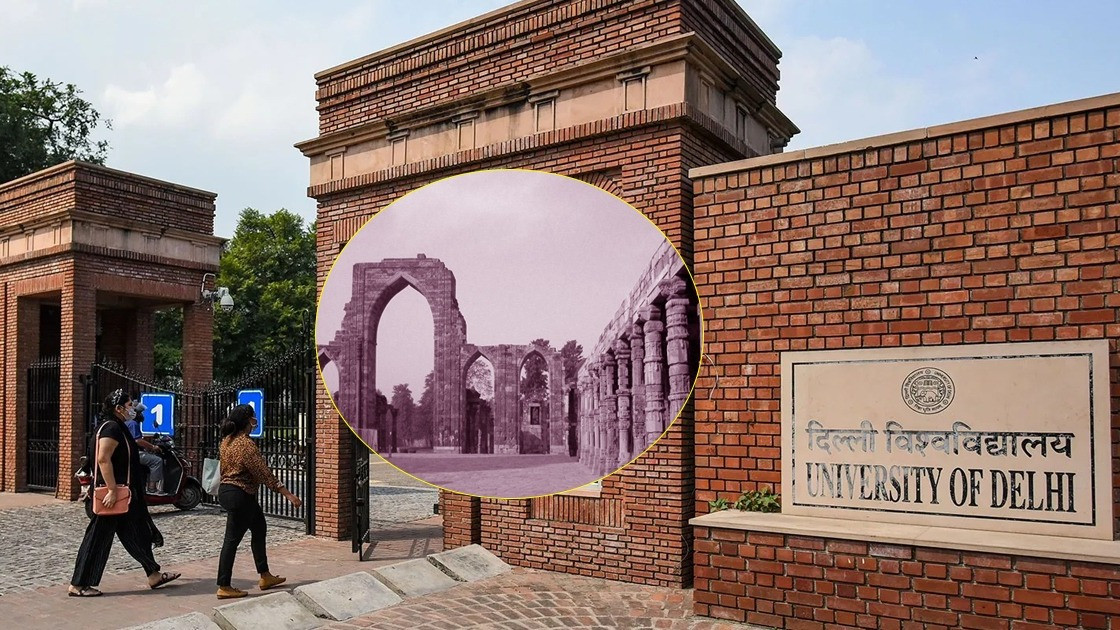
The chapter has been removed from the newly notified DU syllabus.
Delhi University (DU) has removed an entire chapter on the Delhi Sultanate from the postgraduate history syllabus. Students will no longer have the option to choose a course based on the Delhi Sultanate. This course used to study the formation of medieval states, the use of power, and the development of political, religious, and cultural life of that era.
According to a report by Indian Express, the paper titled “The Delhi Sultanate: Structures of Authority in Medieval North India (13th-14th Century)” was taught in the third semester. It has been removed from the newly notified syllabus of DU. Along with this, several other old courses related to medieval, ancient, and modern India have not been included in the new syllabus. Other papers removed from the third semester include “History of North India, circa 1400-1550”, “Gender and Women in Early India: 1500 BCE to 1000 CE”, “Political Processes and Structures of States in Ancient India” and “Religion and Society in Ancient Indian Literature”.
Official records indicate that these courses had received approval at various stages of the syllabus approval process, but they were not included in the final notification issued on August 7. The DU history department had proposed a total of 38 DSE papers, of which only 16 papers were notified for the third semester.
Some similarities exist between the postgraduate papers on “Delhi Sultanate” and “History of North India” and a paper taught in the undergraduate program. However, a faculty member from the history department stated that the two cannot be compared. According to them, the postgraduate paper on the Delhi Sultanate has been a major paper on medieval India for several decades. Meanwhile, the paper on North India was a “specialized thematic and historical study,” whereas the undergraduate paper is a general “survey course” of Indian history.
DSE, or Discipline Specific Elective, is an optional course within a student's subject. For example, it allows a history student to choose a specific area of history for in-depth study instead of only studying compulsory papers.
It is noteworthy that the process of changing the syllabus at Delhi University goes through several stages. First, the department discusses and approves the proposed courses in its Committee of Courses. The proposal then goes to the university's Standing Committee and then to the university's highest academic body, the Academic Council. After approval from the Academic Council, the syllabus is sent to the Executive Council for final approval.
DU's Dean of Academic Affairs, K. Ratnabali, said,
No course has been removed. We took all courses to the Academic Council. The Academic Council gave the Vice-Chancellor the freedom to form an expert committee to review those courses that needed review. This committee included three external experts, the head of the department, and two members of the Academic Council.”
Ratnabali further stated,
The problem was that even after the paper was approved by the Standing Committee, the department made some changes to the approved syllabus. According to her, some papers were added or removed, some units were changed, and some readings were replaced with other material. This created a “lack of trust” and necessitated a review of the syllabus.
She said that the expert committee examined the revised syllabus and approved those courses that were found to be correct for notification. Some more papers are expected to be notified after the committee's review is complete. Sources familiar with the expert committee's review told Indian Express that the committee has suggested changes to some courses to the department. The aim of the review was to give more representation to different regions and historical periods of India in the syllabus and to align it with the objectives of the New Education Policy (NEP).
The head of the expert committee and Vice-Chancellor of Hemvati Nandan Bahuguna Garhwal University, Professor Shri Prakash Singh, did not comment on the matter. Professor Aniruddha Deshpande, head of the history department in DU's Faculty of Social Sciences, also declined to comment. Another member of the Faculty of Social Sciences claimed that a “pattern” is visible in these changes. According to them, since the revision of undergraduate and postgraduate syllabi began under NEP 2020, especially in social sciences, many courses and papers that have been taught for decades are being removed.
In August 2023, Indian Express reported on changes related to the NEP in DU's undergraduate history syllabus. These included removing references related to “Brahmanisation” and removing a paper titled “Inequality and Difference.”
According to the postgraduate syllabus document presented to DU's Academic Council, the course on the Delhi Sultanate aimed to study different historiographical interpretations of the 13th and 14th centuries and to re-understand this period in the context of India's broader history. It studied the political culture of the 13th and 14th centuries and the spiritual and religious traditions of that era.
The second paper, “History of North India, circa 1400-1550,” focused on the period between the disintegration of the Delhi Sultanate and the rise of the Mughal Empire. It studied Afghan political cultures, the spread of political power under different regimes, various forms of patronage, and literary cultures. Additionally, Sufism and Bhakti were also viewed as forms of social and political power. According to faculty members familiar with the curriculum, these two papers were part of the old syllabus of 2019-20 and had been taught in the department for many years.
According to the report, the new syllabus does not only lack papers related to medieval history. The paper “Gender and Women in Early India: 1500 BCE to 1000 CE” studied the status of women in Brahmanical, Buddhist, Jain, and Tantric traditions. It included topics such as marriage, family, property, and stridhan. It also studied the role of women as rulers, patrons, and workers. This course also explored the question of whether a distinct “female voice” could be identified through literary and epigraphic sources. Another chapter removed, “Political Processes and Structures of States in Ancient India,” studied the development of political institutions from early political structures to the Mauryan and Gupta Empires and later regional states. It included topics such as taxation, warfare, bureaucracy, land grants, queens, temples, merchant guilds, and local administration.
It is to be noted that even before the notification was issued on August 7, the history department had expressed concerns about the status of the syllabus. In a formal proposal sent to Vice-Chancellor Yogesh Singh on August 4, the departmental council stated that the new academic session had started on July 28, but the third semester syllabus had not been officially notified by then.