
CEC Gyanesh Kumar given 48-hour ultimatum, CJP announces nationwide movement

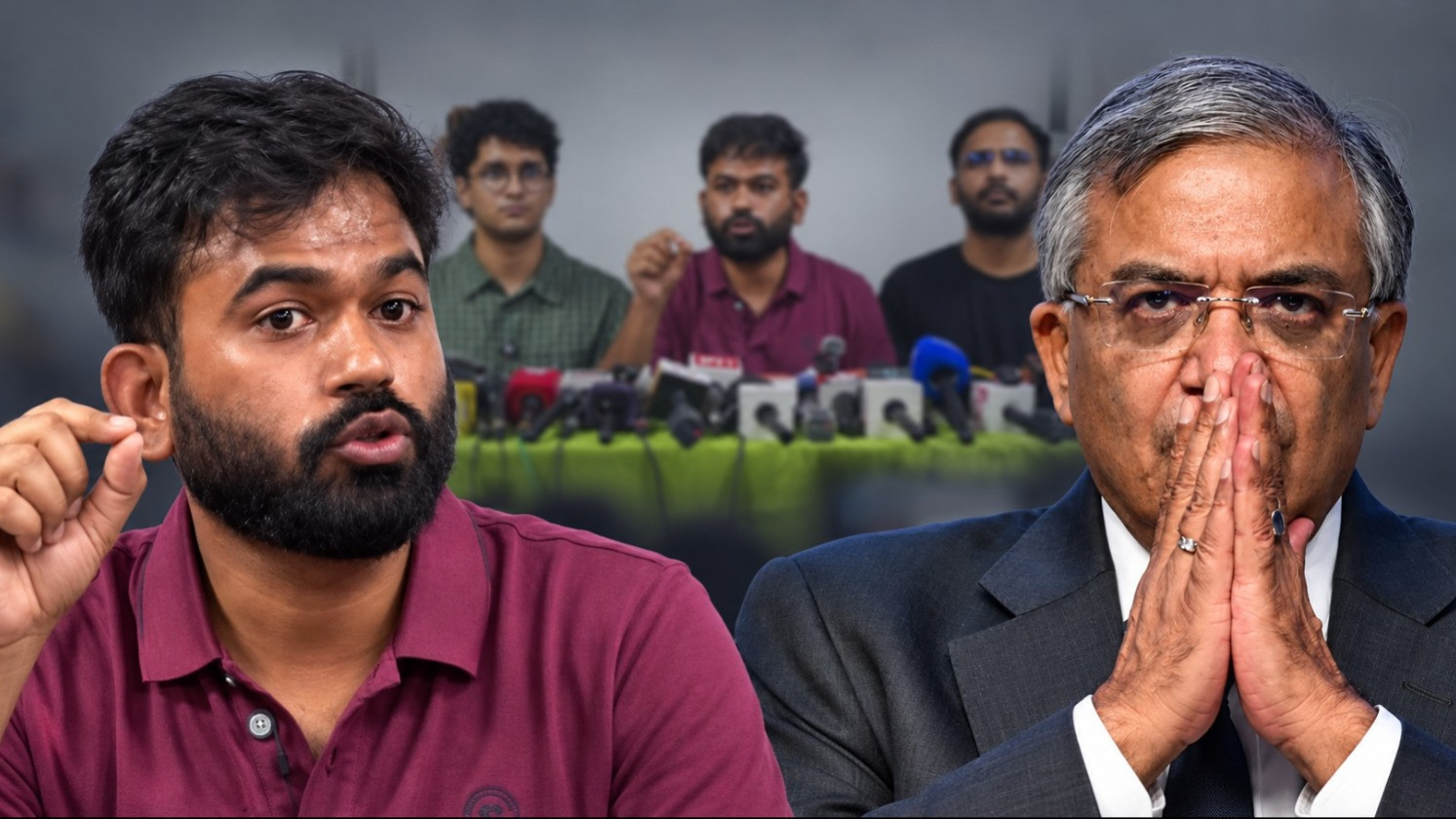
CJP urges clarification on objections raised against two election commissioners.
Cockroach Janata Party (CJP) on Thursday demanded the resignation of Chief Election Commissioner (CEC) Gyanesh Kumar, accusing him of arbitrary actions that undermine the rights of voters. The organization warned that if he does not resign within 48 hours, a nationwide movement will be launched. CJP also mentioned a ‘Jantar Mantar 2.0’ protest in Delhi.
At the press conference, CJP National Coordinator Abhijit Deepke stated that,
If Gyanesh Kumar does not resign within 48 hours, we will first start protests across the country and then protest in Delhi. Jantar Mantar 2.0 will definitely happen.
CJP also demanded,
to stop the removal of names under SIR, to secure the voter lists of January 2025, and to hand over all records and files related to SIR to an independent investigation formed under the Supreme Court or judicial oversight.
The organization also demanded,
the Chief Election Commissioner and the repeal of the 2023 law related to the appointment of other election commissioners. It stated that a system should be brought in place that involves more institutions and civil society participation.
CJP urged Election Commissioner Sukhbir Singh Sandhu and Vivek Joshi to publicly clarify their recorded objections. The organization requested the commission to publish the objection notes, the responses given to them, and the relevant records, so that an independent investigation into the conflicting claims can take place.
It is noteworthy that earlier, CJP had protested against the NEET question paper leak at Jantar Mantar in New Delhi. Following that movement, Union Education Minister Dharmendra Pradhan resigned on July 25. Initially started as an online platform, CJP is now functioning as a pressure group, and the issue related to the Election Commission has become the new focus of its campaign. CJP spokesperson Saurav Das stated in a video that if questions remain about the electoral system, efforts to hold the government accountable and bring about change will not succeed.
CJP's demand comes after a report by The Indian Express, which stated that Election Commissioner Sukhbir Singh Sandhu and Vivek Joshi had raised written objections at least 14 times regarding decisions related to special intensive review (SIR) taken without their knowledge in the past 10 months. The report also mentioned the illegal provisions added to Form 6.
However, the Election Commission acknowledged the existence of these comments but stated they were part of its ‘decision-making process’. The commission did not directly respond to the concerns of both commissioners and did not clarify whether they were resolved. In a press note signed by Deputy Director P. Pavan, the commission stated that differing opinions and comments within any institution are a normal part of discussions. According to the commission, the written notes from members, technical suggestions, and internal reviews were part of regular procedures, and the commissioners' suggestions were made to improve the electoral process.
CJP announced that its
‘Fix the Election Commission’ campaign will focus on the issue of over 1.3 crore names being removed from draft voter lists during SIR across 30 states and union territories.
Deepke stated that,
Democracy means that people choose their government. This is not democracy; it is autocracy. Under Gyanesh Kumar's tenure, we are witnessing an electoral system where the Election Commission decides whose name will remain in the voter list and whose will not. When millions of names can be removed from draft lists, it is the commission's responsibility to prove that the removal of each name is lawful and transparent and that there is an effective review mechanism in place.
He further stated that,
two out of three election commissioners had formally objected to decisions being made without their knowledge or approval. According to them, the commission should publicly state how these objections were addressed and who approved the relevant decisions.
Saurav Das has demanded an immediate investigation into three issues.
The first issue is
the obstruction in the registration of first-time voters after the addition of an extra declaration in the online Form 6. Under this declaration, new applicants are being asked to provide information about their or their parents' names being present in the previous SIR voter lists.
The second issue is the resolution of appeals from those excluded from the voter list in West Bengal. Das has demanded the public disclosure of information regarding cases related to SIR, appeals, and the legal steps taken by the commission in this regard. The third issue is the centralization of voter list data.
Das stated that,
the Election Commission cannot ask citizens to trust any arrangement while refusing to disclose how major changes related to voter registration, name deletions, and access to data are being approved. Every decision affecting a citizen's right to vote should have a clear legal basis, an accountable officer, and a transparent record.
Ashutosh Ranka mentioned that the removal of actual voters' names from the list could have repercussions beyond the elections, as voter records are also used in administrative verification. He questioned the commission about who granted approval for name deletions without ensuring a transparent and accessible appeal system.
Ranka said that,
the right to vote is a protected constitutional right under Article 326 of the electoral framework. The commission must respond to those citizens whose names have been removed.
In addition to Gyanesh Kumar's resignation, CJP has demanded an independent investigation into the decisions made during the SIR. The organization wants the investigation to identify the officials who approved the controversial changes and directives.